
Extreme Fan-Out
One write. Every real dependent recomputes — and only what actually changed goes further.
Live fan-out. A real this.me kernel in your browser: one line per dependent of master.factor, the recompute order replayed at the measured duration (needs JavaScript).
.me is a reactive kernel. Facts live at paths (master.factor); a derived value, declared once with ["="], recomputes when one of its inputs changes. The work a write causes is its wave, and k is the size of that wave: how many derived values it recomputed. me.explain(path) returns the formula, its inputs and the last wave (k, recomputed, changed, sourcePath).
Fan-out is the case where k is large on purpose: many values read the same input, so one write has to reach all of them.
The 100,000-dependent demo
The opposite of Hemisphere Scale. There, k was tiny and the graph was huge. Here, k is intentionally enormous: every single node in the graph depends on one root value. Change the root — measure how long it takes to recompute all 100,000 leaves.
.me Docs · Extreme Fan-Out Source Code
The Tiny Mental Model
me.master.factor(1)

// 100,000 nodes, each derived from the same root
me.dep[i]["="]("out", "value * master.factor")

// one write
me.master.factor(2)
// → all 100,000 `out` values recompute
O(k) is honest — if k is 100,000, the cost is 100,000. The point is: the graph never recomputes more than k.
On real data the same rule holds: in a transit feed most writes have k = 1 and the widest parent sets the tail (measured on real data in GTFS-Madrid →), and k does not grow when the data does (k vs n →).
What The Demo Builds
| Part | Path | What it means |
|---|---|---|
| Root | master.factor |
The one value everything depends on |
| Leaves | dep[i].value |
Each node’s own base value |
| Derived | dep[i].out |
value * master.factor — live for all 100k |
Step 1: Wire 100,000 Dependents
me.master.factor(1)

for (let i = 1; i <= 100_000; i++) {
  me.dep[i].value(i)
  me.dep[i]["="]("out", "value * master.factor")
}
Every node declares its derivation at setup time. The dependency graph is built once.
Initial state:
me("dep[1].out")       // 1
me("dep[100000].out")  // 100000
Step 2: Mutate the Root
me.master.factor(2)
All 100,000 leaves recompute:
me("dep[1].out")       // 2
me("dep[100000].out")  // 200000
Explainability
The cascade is fully traceable:
me.explain("dep[100000].out")
// → {
//     expr: "value * master.factor",
//     dependsOn: ["dep.100000.value", "master.factor"],
//     k: 100000,
//     sourcePath: "master.factor",
//     recomputed: ["dep.1.out", "dep.2.out", ..., "dep.100000.out"]
//   }
k: 100000 — the graph recomputed exactly as many nodes as depended on master.factor. No more, no less.
The trace is complete, so it is as large as the wave: see Known limits.
Build It Yourself
cd Typescript
npm install
node tests/Demos/Root_Fanout_100k.ts
Override N:
FANOUT_N=50000 node tests/Demos/Root_Fanout_100k.ts
To run every demo:
npm run test:demos:run-all
The Big Idea
Fan-out is not a pathological case. It is the natural shape of broadcast: one configuration value, one price, one policy — many things that depend on it.
.me handles it without special-casing. The same O(k) guarantee that makes Hemisphere Scale cheap also makes Extreme Fan-Out correct: the graph recomputes everything that needs to change, and nothing that does not.
1 root mutation → k=100,000 → mutation time measured in milliseconds
Known limits
explain()grows with k. It lists every recomputed path, about 1.9 KB plus 56 bytes per recomputed value. On a trip with 14,378stop_timesit returns about 1.6 MB (GTFS-Madrid →). There is no pagination or summary mode yet; that is an open item.- Deletes do not follow k yet. An update costs about k; a removal (
me["-"]) also scans the store, so it grows with the size of the data (DELETE on GTFS-Madrid →). Open.
 BenchmarkGTFS-MadridThe same kernel on a real transit feed: k as the data grows, skewed fan-out, deletes.
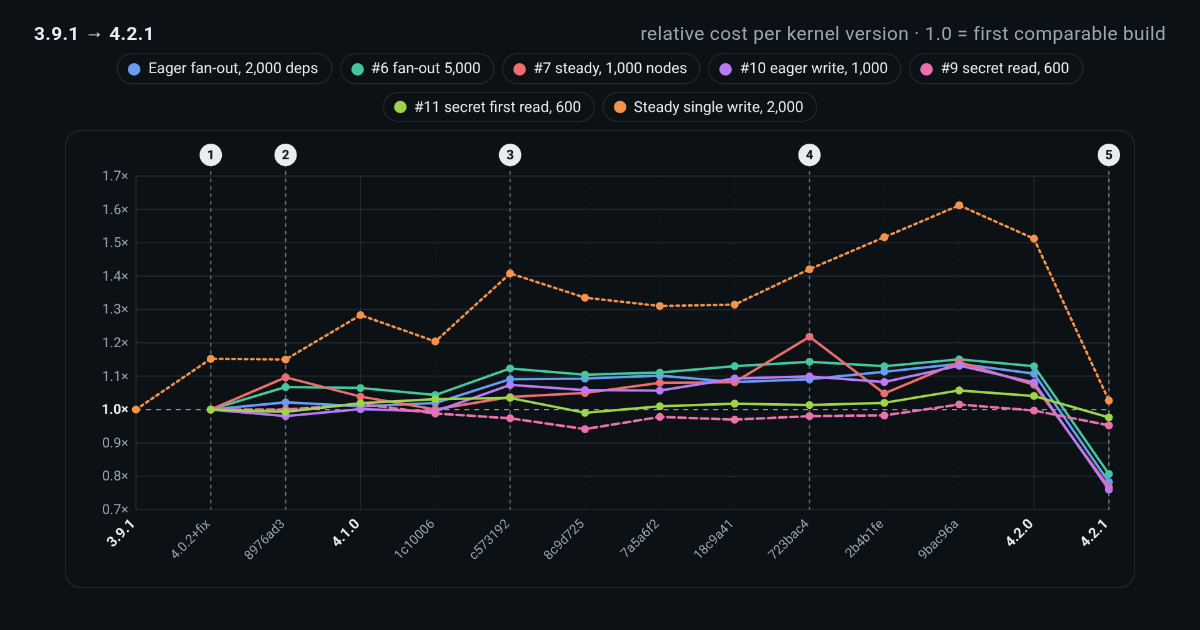 BenchmarkKernel benchmarksFan-out, sustained writes and reads, measured across versions.
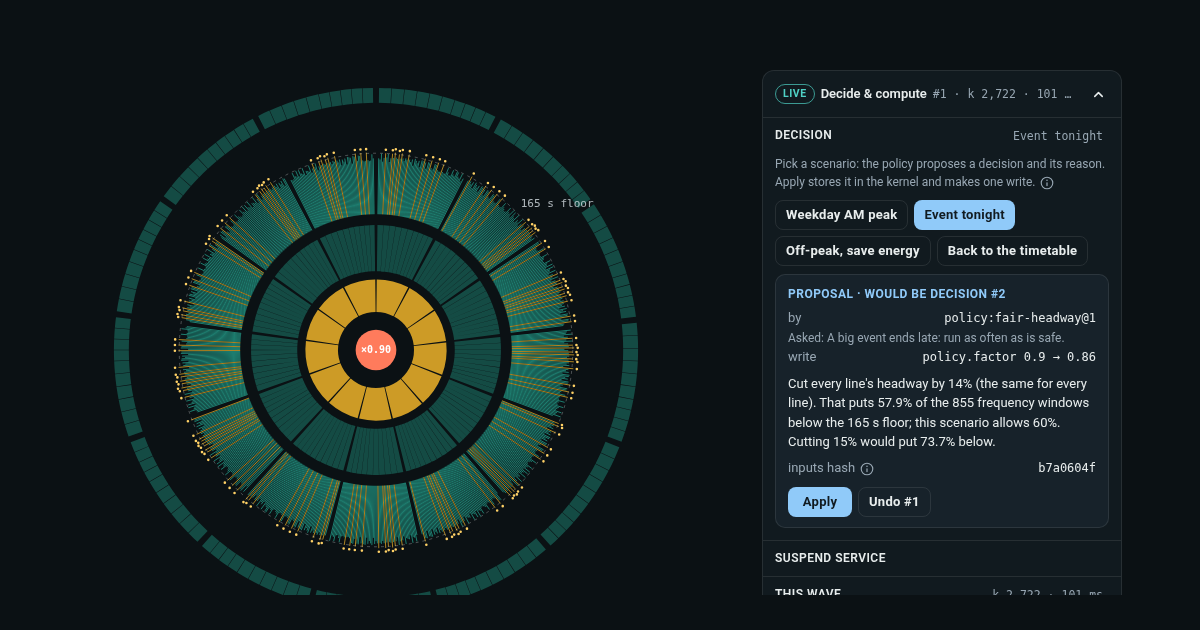 DemoAI decides, .me computesThe same waves on GTFS-Madrid-Bench: a policy decides a headway change, one write, explain() back to the decision.
 DemosSmart CitiesCity demos on .me: Madrid transit, the Port of Veracruz, a hospital.
 DocsHemisphere ScaleThe opposite case: 1 million nodes, one write, k = 6.