
Meta adapter
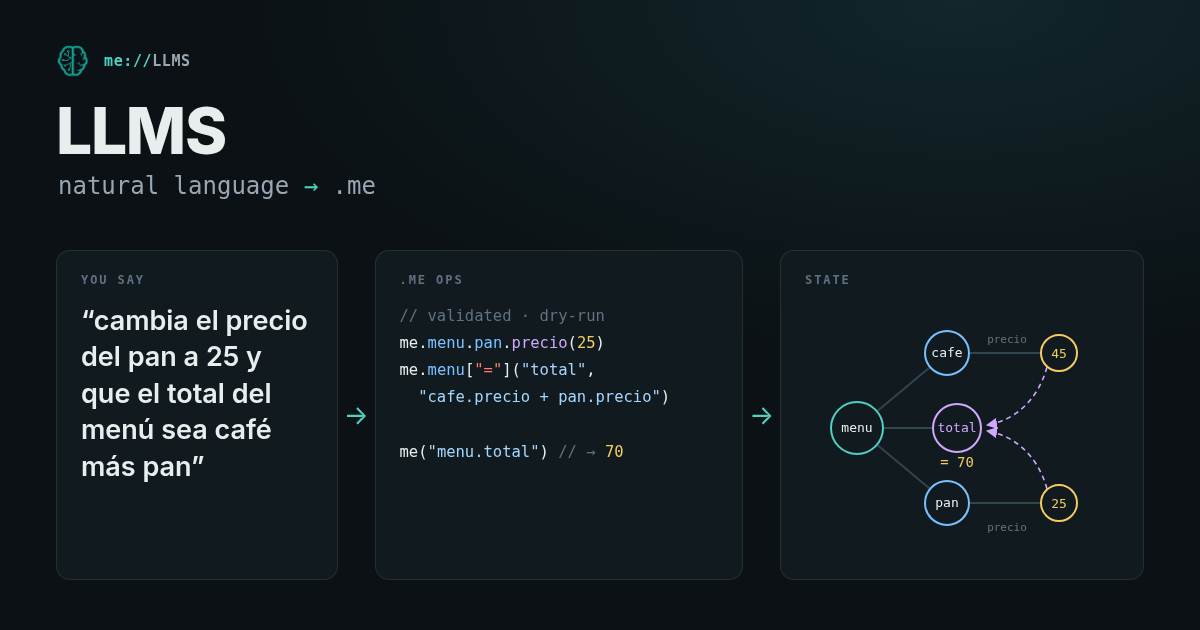
metaModel() turns the Meta Model API into a ChatModel: a function from chat messages to reply text. You pass it to parse(), which turns a sentence into .me ops, validates them and dry-runs them. The adapter only talks to the API; checking the ops is the core’s job.
Install
The package (llms-me 0.1.0) is not on npm yet (planned). Use it from the repo. It is TypeScript run directly by Node (engines: node >=23.6) and depends on this.me ^4.2.1.
git clone https://github.com/neurons-me/.me.git
cd .me/LLMS/typescript
npm install
npm test        # mocked model, no network
Key and settings
| variable | used for | default |
|---|---|---|
META_API_KEY |
API key, required | none |
META_BASE_URL |
API base URL | https://api.meta.ai/v1 |
META_MODEL |
model name | muse-spark-1.3 |
Set the key in your environment. The key only goes into the Authorization header; the adapter never logs, throws or returns it. If no key is set, metaModel() throws Meta Model API: META_API_KEY is not set.
API
metaModel(options?) => ChatModel from src/adapters/meta.ts. Every option overrides the matching variable above.
| option | type | default |
|---|---|---|
apiKey |
string | META_API_KEY |
baseUrl |
string | META_BASE_URL, then https://api.meta.ai/v1 |
model |
string | META_MODEL, then muse-spark-1.3 |
temperature |
number | 0 |
fetchImpl |
typeof fetch |
global fetch (pass a mock for tests) |
It sends POST {baseUrl}/chat/completions with { model, messages, temperature } and returns choices[0].message.content. Requests time out after 60 s. Errors read Meta Model API <status>: <code>, request failed (timeout) or reply has no message content.
META_DEFAULTS exports the default base URL and model.
Usage
import { parse } from "./src/index.ts";
import { metaModel } from "./src/adapters/meta.ts";

const model = metaModel();               // reads META_API_KEY
const r = await parse(
  { text: "Luis is 30 years old", state: {}, speaker: "luis" },
  { model, maxRepairs: 2 }
);
if (r.ok) console.log(r.ops, r.diff, r.needsConfirm);
else console.log(r.errors);
parse(input, options):
input:text(required, cut at 4000 characters), optionalstate(current .me as nested JSON),schema,namespace,speaker.options:model(required),maxRepairs(0–2, default 2),secretPaths(their values are sent to the model only as<secret>),examples.
What you get back
parse() returns a ParseResult:
| field | meaning |
|---|---|
ok |
true when the ops passed the schema, the path rules and the dry-run |
ops |
validated ops: set, define, pointer, remove, secret, noise, identity, query |
needsConfirm |
the secret, noise, identity and remove ops; ask the user before applying them |
diff |
{ path, before, after } for each path the dry-run changed |
reads |
values read by query ops |
errors |
why it failed, when ok is false |
attempts, raw |
tries used and the raw model replies |
If the reply fails a check, the exact errors go back to the model and it tries again, up to maxRepairs times. parse() never writes to a real .me. To apply ops, call applyOps(me, ops, { confirm, secretKeys }): confirm-ops throw without confirmation, and secret / noise need a key typed by the user.
Measured
Eval on our own 30 ES/EN items with muse-spark-1.3 (2026-10-28): 30/30 valid, 22/30 exact ops, 24/30 same final state, 30/30 correct needsConfirm, median latency 2.97 s. Few items, so read it as a smoke test. Run it with npm run eval -- --adapter meta.
Not there yet
- npm package
llms-me(planned). metaModel()does not exposetimeoutMs(fixed at 60 s) orresponse_format; whether api.meta.ai honorsresponse_formatis unverified.- Streaming is not supported; the adapter waits for the full reply.
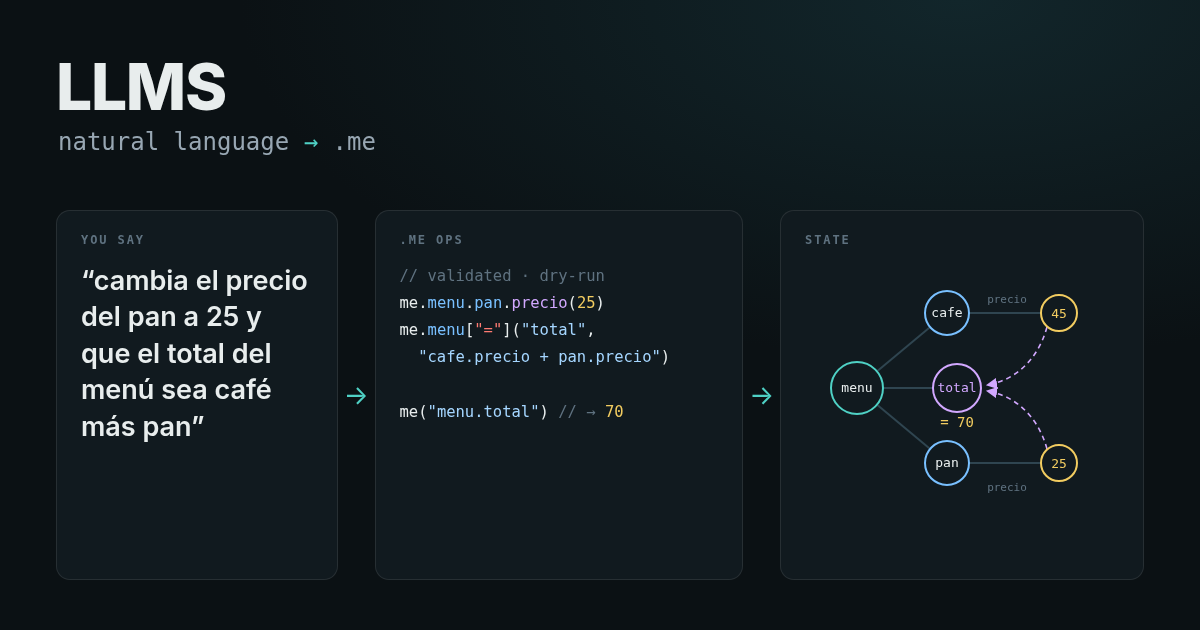 DemoLLMS heroSentences in several languages, the ops muse-spark-1.3 produced for them, computed on the real this.me 4.2.1 kernel in your browser.
 EvalMeta eval resultsEvery item: text, ops, valid, exact, final state, latency.
Source: adapters/meta.ts · openai-compatible.ts · parse.ts